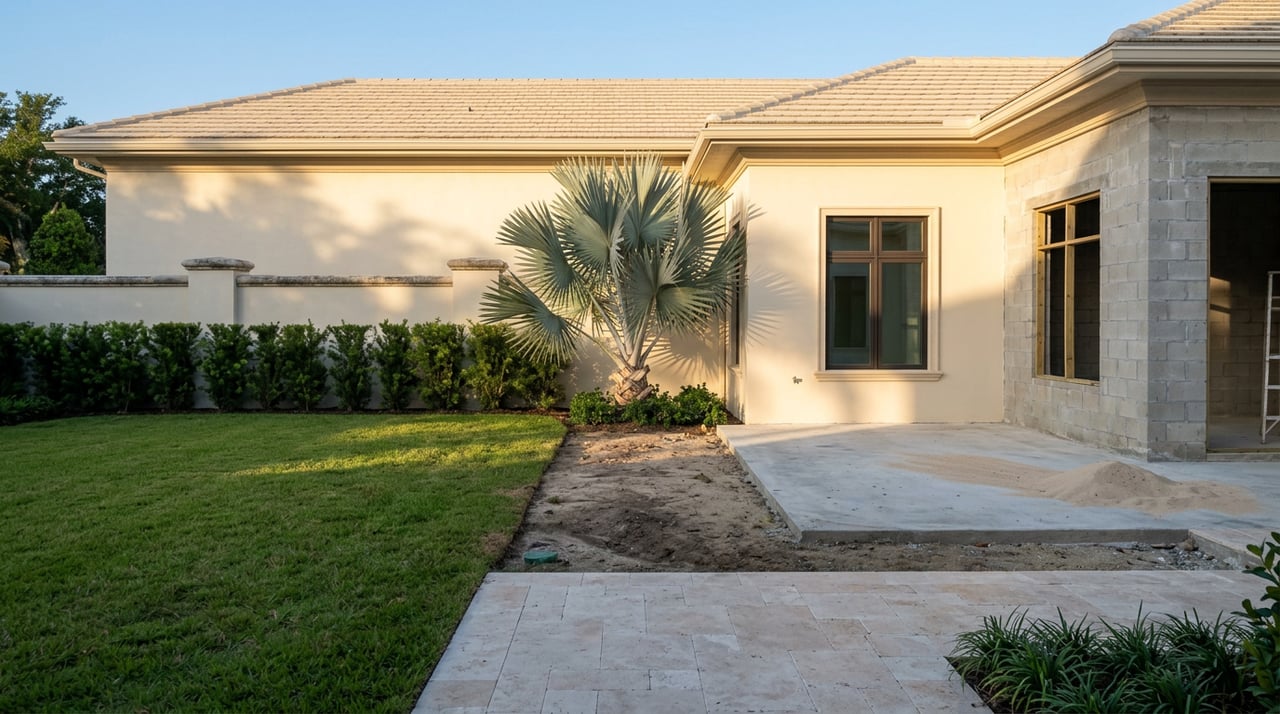
In May 2026, Douglas Durst and his wife Susanne sold a house at 1333 North Lake Way for $14.9 million. The house was built in 1956. It measures 2,800 square feet, sits on 0.6 acres, and had been in the Durst family since they bought it for $2.9 million in 2015. Do the math on that sale price and you get roughly $5,321 per square foot, a number that would make sense for a fully renovated oceanfront trophy but reads as absurd for a decades-old four-bedroom cottage that nobody had touched.
Nobody paid $5,321 a square foot for that house. They paid for 0.6 acres on North Lake Way, and the house happened to be sitting on it. The deed records a price per square foot because that's the unit real estate uses to record every sale, but the number is a costume. Underneath it is a land transaction wearing the clothing of a livable-condition sale.
That distinction matters more than it sounds like it should, because Palm Beach's most quoted market statistic, the town's median price per square foot, is built by averaging exactly these two kinds of sales together. One kind prices the house. The other prices the dirt. A buyer who treats the blended number as a single, consistent measure of value is going to misread whatever listing they're looking at, and the mistake runs in both directions.
A Median Built From Two Different Ledgers
The town-wide numbers tell a clean story on the surface. The median single-family sale in Palm Beach ran about $8 million in 2021 and reached roughly $12.9 million for the period from January 2021 through August 2026, a 62 percent climb. Median price per square foot moved from about $1,988 to around $3,168 across that same stretch. Days on market more than doubled, from 44 in 2021 to roughly 112 now, which reads less like a cooling market and more like buyers who no longer need to move at auction speed.
Those figures are accurate, and they're also an average of two populations that behave nothing alike. On one side sit renovated, systems-current homes where the price genuinely reflects the interior: the kitchen, the impact windows, the pool deck, the finish level. On the other side sit properties where the structure is incidental and the land, the lot dimensions, the water frontage, or the entitlements already secured are doing all the pricing work. Blend those two populations into a single median and you get a number that's true for the town and useless for any one house.
Same Metric, Opposite Story
Look at four transactions from 2026 side by side and the split becomes obvious.
| Property | Condition | Price | Square Feet | Effective $/sqft | What it actually reflects |
|---|---|---|---|---|---|
| 1333 North Lake Way | Original 1956 structure | $14.9M | 2,800 | ~$5,321 | Land value on a 0.6-acre lot |
| Mosie Miller's waterfront flip | Fully renovated | $30.8M (bought $21.6M in 2023) | Not disclosed | N/A | Value created by renovation |
| 757 Island Drive | Under construction, approved plans | $93.3M (bought as land for $39.5M in 2021) | ~11,600 planned | ~$8,043 | Entitlements and construction progress, not finishes |
| 614 Tarpon Way | Existing waterfront estate | $37.1M | 8,600 | ~$4,314 | Waterfront position plus a recently divided legacy parcel |
Two of these sales are genuinely about the house. Two are almost entirely about something else standing next to the house.
What Renovation Actually Buys
The Miller sale is the cleanest example of the livable-condition market working the way people assume Palm Beach real estate always works. He bought the waterfront property for $21.6 million in 2023 and sold it renovated for $30.8 million in April 2026, a gain built on the interior work itself rather than on the land underneath it changing hands twice. That's the transaction type most buyers picture when they hear "Palm Beach price per square foot": pay for square footage that has been meaningfully upgraded, and the market rewards the upgrade.
On Palm Beach Island, the house is often the least reliable part of the price.
The North Lake Way sale sits on the opposite end of the same spectrum. The Dursts held the house for a decade without renovating it, and the buyer, aerospace executive Austin C. Willis, paid a number that had nothing to do with the four bedrooms or the four bathrooms inside. He paid for the location, the lot, and whatever gets built there next.
The Entitlement Premium
The 757 Island Drive sale pushes the same principle further. The 0.9-acre corner lot on Everglades Island sold as raw land for $39.5 million in 2021. In 2022, the town approved plans for an 11,600-square-foot mansion with nautical detailing. By May 2026, the property, still under construction with no interior finishes selected, sold for $93.3 million. The price more than doubled while the only thing that changed on site was a foundation, framing, and a stack of approved permits.
That's not a story about square footage at all. It's a story about how much of a Palm Beach sale price gets locked in the moment a project clears the town's approval process, long before a buyer ever picks a countertop. Anyone comparing that sale to a renovated resale on a price-per-square-foot basis is comparing two different products that happen to share a unit of measurement.
The 614 Tarpon Way sale adds a smaller wrinkle to the same idea. The 8,600-square-foot estate sold for $37.1 million, and it sits next to a separate lot the same ownership entity had recently sold on its own. When a legacy holding gets divided before a sale, the remaining parcel's boundaries, and therefore its true land value, may not match the assumptions built into an older listing history or an outdated plat.
The Same Distortion Shows Up Off the Residential Side Too
The pattern isn't unique to houses. A commercial office building at 317 Peruvian Avenue in Midtown, a block off Worth Avenue, sold in August 2025 for a recorded $8.4 million, or about $1,302 per square foot. It changed hands again in an off-market deal recorded on September 1, 2026, this time for $17.475 million, or roughly $2,708 per square foot. Same 6,454-square-foot building. No renovation between sales. The per-square-foot figure more than doubled on the strength of location, timing, and how the deal was negotiated, not because a single wall moved.
That's the same lesson the residential market keeps delivering in different packaging: a price-per-square-foot number only means what you think it means when you know what actually drove the sale.
Reading a Comp Before You Trust It
Before leaning on any per-square-foot figure to judge whether a Palm Beach listing is priced fairly, it helps to ask a few questions the number itself won't answer. Is the structure's age and condition consistent with the finish level implied by the price, or does the price look disconnected from what's actually standing on the lot. Has the parcel been divided, combined, or had entitlements attached to it recently, the way 757 Island Drive and 614 Tarpon Way had. And is the comparable sale you're using a renovated, livable-condition transaction, or a land sale wearing a square-footage number for recordkeeping purposes.
None of this means the town median is wrong. It means the median is a summary of a market that runs on two different logics at once, and the only way to use it well is to first figure out which logic applies to the specific house in front of you.
A Few Questions We Hear Often
How can I tell if a listing is being priced as land rather than as a house? Look at the structure's age relative to its systems and finish level, and check whether the marketing language leans on lot dimensions, water frontage, or rebuild potential rather than interior features. A dated structure priced well above the town's livable-condition median per square foot is usually signaling that the land is the product.
Does a fully renovated home ever sell for less than the land underneath it would justify on its own? It can happen when the surrounding land value has moved faster than the renovation added value, particularly in a market where the per-acre floor for prime parcels has climbed as it has in 2026. A strong renovation still adds real value, as the Miller sale shows, but it doesn't insulate a property from a land market that's repricing underneath it.
Reading a Palm Beach comp takes more than a spreadsheet of square footage and sale prices. It takes knowing which market a specific transaction actually belongs to before you decide what it proves. If you're weighing a purchase or a listing on the island and want a second opinion on which side of that split your property sits on, Kassandra & Thalia is glad to walk through the comps with you and schedule a free consultation.