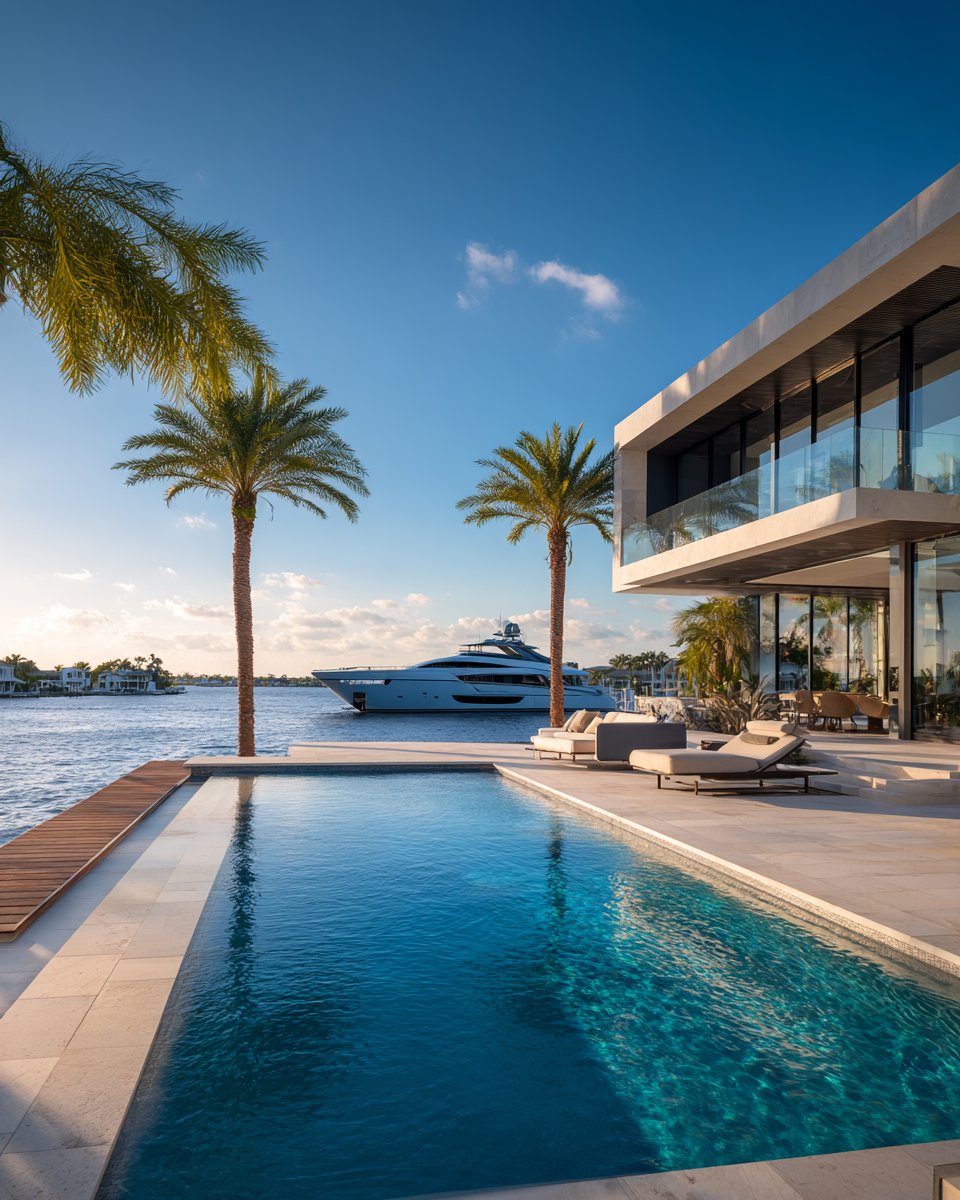
Picture two homes on the same Jupiter canal. Same builder era, same square footage, same quartzite counters and screened pool cage. One has a seawall poured in the mid-2000s with no permit on file. The other's seawall was replaced two years ago with a full paper trail to match. On a listing sheet, they read as interchangeable. At the closing table, they are not. One clears underwriting in a few weeks. The other stalls, gets re-quoted by a second carrier, or loses the buyer altogether.
That gap is the story of Jupiter's waterfront market right now. The number that actually decides what a buyer pays over time rarely shows up in the listing description. It shows up in a seawall inspection report, a dock permit file, and an insurance quote that has started reading the property instead of the map.
The Question That Now Comes Before the Offer
Buyers shopping the Loxahatchee River, the Intracoastal corridor, and the canal communities running through Jonathan's Landing and the Admirals Cove area are asking for elevation certificates, flood zone documentation, and seawall inspection reports as a standard part of an offer, not as a nice-to-have. That shift did not happen because buyers got more cautious for its own sake. It happened because the cost of getting it wrong along tidal water in Jupiter has become large enough to underwrite around.
Owners along the river are also thinking further out than the next closing. Tidal flooding events, often called king tides, are a real and recurring feature of life on the Loxahatchee. Seawall integrity, lot elevation relative to the neighbors, and the drainage capacity of an older community are now evaluated with a seriousness that a five-year-old comparable sale simply did not require.
What a Seawall Actually Costs
Seawall replacement projects along the Loxahatchee routinely run $150,000 to $400,000 or more, depending on linear footage and site conditions. That range alone can rewrite a buyer's math on a home that looked competitively priced on day one. And a seawall rarely fails alone.
| Waterfront cost layer | What drives the number |
|---|---|
| Seawall replacement | Linear footage and site conditions, typically $150,000 to $400,000-plus |
| Dock reconstruction | Bringing an older structure up to current code |
| Boat lift | Vessel size and tidal depth at the site |
| Dredging | Often needs review at both the state and federal level |
Dock reconstruction and code-compliance upgrades add another layer of capital requirement on top of a seawall project. Lift systems for larger vessels, mangrove trimming regulations, and permitting timelines all extend the cost and time burden of waterfront ownership in Jupiter and across northern Palm Beach County. None of this is visible from the dock itself. It becomes visible in a contractor's written estimate, which is exactly why more buyers are ordering one before they remove a contingency.
Who Actually Owns the Water Under the Dock
Here is the part of Jupiter waterfront ownership that surprises even careful buyers. A home's four walls and the land under them are one legal question. The submerged land under the dock is a different one entirely.
Florida statute 253.0347 governs private residential dock leases on sovereign submerged land and requires the Department of Environmental Protection to inspect these sites periodically to confirm the lease still matches what is actually built.
Disputes over exactly where that boundary sits, and who holds the authorized interest in it, are not rare. The Florida Bar's own journal has documented cases where the legal shoreline for a property turned out to sit somewhere entirely different from where the seawall now stands, particularly on lots shaped by decades-old dredging. One Florida Bar Journal analysis walks through exactly this kind of dispute, where a cease-and-desist letter over a newly built dock turned into a fight over where the historic high-water line actually fell.
This matters at closing because an existing seawall or dock that was never properly authorized does not just carry a theoretical risk. Florida's submerged lands rules require the property owner to furnish evidence of riparian ownership before the state will authorize any new activity at that site, which means an unpermitted structure can sit there quietly for years and then block approval for a new dock, a lift, or even a straightforward repair the day a new owner tries to build on it. A legal overview of the state's submerged land rules lays out how these ownership-evidence requirements now have to be satisfied earlier in the process than they once did.
Insurance Has Stopped Reading the Flood Zone Map
For years, a home's flood zone designation was most of the insurance story. That has changed. Under FEMA's Risk Rating 2.0 methodology, premiums are built from the property up, using finished floor height relative to modeled water levels, distance to the nearest flood source, foundation type, full replacement cost, and the local risk pattern around the parcel. The zone still matters for permitting and for some lender requirements, but it no longer sets the price by itself.
The practical result is that two homes on the same street, even the same canal, can carry very different premiums. A house on pilings a few feet above code will often rate better than an older home nearby with a slab foundation near grade, even if both sit in the same flood zone. Along the Loxahatchee, some homeowners have seen double-digit percentage premium increases year over year without ever filing a claim, as carriers tighten underwriting around seawall condition, roof age, elevation certificates, and how windstorm and flood coverage stack together on a single policy. A home that is genuinely well built and well maintained can still be flagged as uninsurable or near-uninsurable based on roof age, elevation data, or seawall condition alone. That is the harder version of the thesis: the insurance conversation is no longer just an ownership cost line item. It is a valuation variable that shows up before the appraisal ever gets ordered.
The Town's Rule That Changes the Math on a Renovation
For anyone eyeing a waterfront fixer along the river with plans to update it, Jupiter has a rule worth knowing before the renovation budget gets built. An improvement to a structure located in a Special Flood Hazard Zone is classified as a "substantial improvement" once the cost of the work reaches 50 percent or more of the structure's market value. Once that threshold is crossed, the entire project has to bring the structure into compliance with current flood provisions, according to the Town of Jupiter's own flood mitigation guidance. For a buyer running renovation numbers on a value-add waterfront property, that 50 percent line can be the difference between a straightforward cosmetic project and a full elevation-and-compliance job.
The Inlet Itself Is Still an Active Project
None of this happens in a vacuum. The Jupiter Inlet District, an independent taxing district established by the Florida Legislature in 1921, maintains the Jupiter Inlet and the navigable channels feeding the Loxahatchee River, all within the larger Loxahatchee River-Lake Worth Creek Aquatic Preserve. Dredging and beach fill work in that system runs through the U.S. Army Corps of Engineers and the Florida Department of Environmental Protection, and in 2026 the district awarded the contract for its Jupiter Inlet Sand Trap Dredging and Beach Nourishment Project. For anyone buying a boat-access home, that is a reminder that channel depth and inlet conditions are a maintained, evolving system, not a fixed feature of the property.
What This Means Before You Write an Offer
- Ask for the seawall's original permit and its most recent inspection record, not just a walkthrough with the listing agent.
- Confirm whether the dock's lease, easement, or letter of consent for the submerged land is in the current owner's name and still active.
- Get an elevation certificate and a same-week quote from two carriers before any financing contingency comes off the contract.
- If renovation is part of the plan, check the home's current market value against the town's 50 percent substantial improvement threshold before finalizing a budget.
- Have a licensed marine contractor produce a written structural report your lender can actually use. Jupiter-based JKT Marine Construction offers free structural seawall inspections for buyers and their agents, with written reports suitable for lender review and closing documentation.
A Few Questions We Hear Often
How long does dock or seawall permitting take in Jupiter? It depends on scope. A project touching sovereign submerged land, mangroves, or a federally regulated waterway can move through the Florida Department of Environmental Protection and, where dredging is involved, the U.S. Army Corps of Engineers, with each layer adding its own review window.
Does the flood zone tell me what insurance will actually cost? Not by itself anymore. FEMA's Risk Rating 2.0 methodology weighs finished floor height, foundation type, and distance to the water alongside zone designation, so two homes in the same zone can land on very different premiums.
Waterfront due diligence in Jupiter has quietly become a different discipline than it was five years ago, and the buyers who treat it that way are the ones who close without surprises. If you are evaluating a Loxahatchee or Intracoastal property and want a clear-eyed read on what the seawall, the dock lease, and the insurance file actually say about a home's real carrying cost, Kassandra & Thalia can walk the numbers with you before you write the offer. Schedule a free consultation and let's look at the whole picture, not just the view from the dock.
This article is general information, not legal, tax or financial advice. Consult a qualified professional about your situation.